Physical Address
304 North Cardinal St.
Dorchester Center, MA 02124
I Want to Believe
I Want to Believe

A confiscated drum, an invisible percussionist, and a household terrorized after dark. In 1663, investigator Joseph Glanvill entered the haunted home—and reported encountering something he could not explain.
It began with a wandering drummer, a suspicious permit, and one very bad decision.
In the early 1660s, an English landowner named John Mompesson confronted a traveling drummer called William Drury near the Wiltshire village of Tedworth—now known as Tidworth. Drury was accused of collecting money under questionable authority, and his drum was confiscated.
The instrument was eventually delivered to Mompesson’s home.
That was when something allegedly began playing it.
According to accounts from the period, the Mompesson household soon heard heavy drumming outside the house. The invisible percussionist reportedly performed late at night, often just as the family settled into bed.
Before long, the disturbance moved indoors.
Family members described scratching beneath the children’s beds, pounding on doors, strange lights, foul smells, and objects moving without visible assistance. Beds reportedly shook and, in some versions of the account, rose from the floor while terrified children clung to them.
The noises did not behave randomly. Witnesses claimed the unseen drummer could imitate rhythms tapped by people inside the house, almost as if whatever haunted the property were listening—and answering.
Then came an especially troubling detail: William Drury was reportedly imprisoned during part of the disturbance.
If he was responsible, how was he doing it from behind bars?
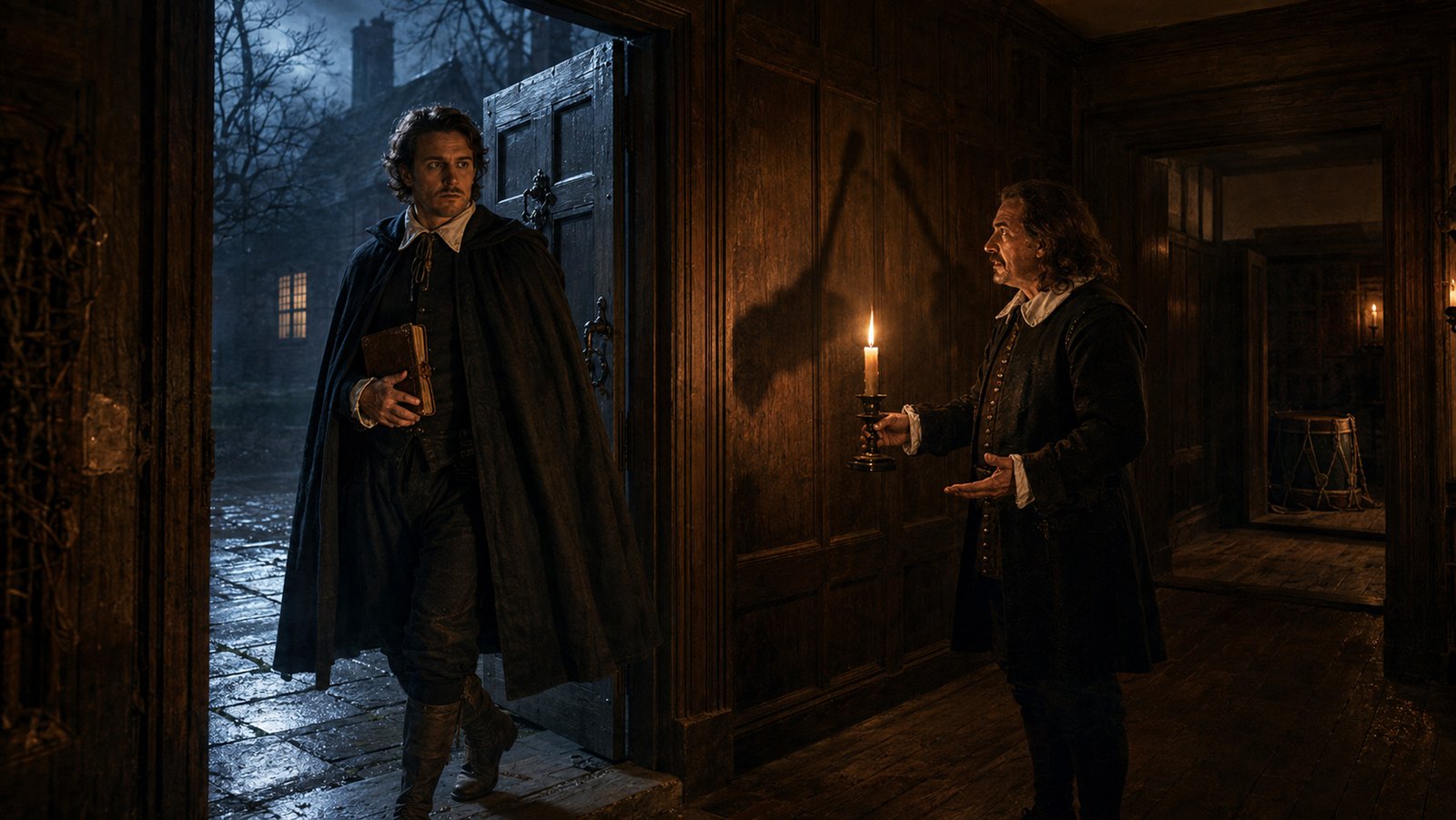
On January 20, 1663, Oxford-educated clergyman and philosopher Joseph Glanvill traveled to Tedworth to investigate the disturbances for himself.
Glanvill spent one night in the Mompesson home. After the children were placed in bed, a servant announced that the activity had returned. Glanvill went upstairs with Mompesson and another gentleman.
As he approached the children’s room, Glanvill reported hearing loud scratching from behind their pillows. Two young girls were lying in the bed, but he could see their hands above the blankets.
He reached behind the pillow, and the scratching immediately moved to another part of the bed. When he withdrew his hand, the sound returned to its original location.
Glanvill then tried an experiment.
He scratched the bedsheet in several numbered patterns—first five times, then seven, and finally ten. According to his account, the unseen source copied each pattern and stopped at the correct number.
He searched beneath the bed, examined the bedding, checked the wall, and looked for any hidden person, animal, or mechanism. He found nothing.
The activity then appeared to move beneath the children. Glanvill described hearing something panting like an exhausted dog while the bed pushed upward against his hand. The movement reportedly became strong enough to shake the room and its windows.
Nearby, a linen bag began moving as though a small animal were trapped inside. Glanvill grabbed the bag and searched it from end to end.
It was empty.
He later reported hearing heavy knocking outside the room where he slept. Glanvill left Tedworth convinced that the disturbances had been produced by what he called a spirit or invisible entity.
He published the case in A Blow at Modern Sadducism in 1668. A longer version appeared in the posthumous 1681 collection Saducismus Triumphatus, helping to turn the haunting into one of England’s earliest widely documented poltergeist cases.
But Glanvill was hardly a neutral investigator. He already believed that spirits and witchcraft were real, and he regarded evidence of the supernatural as a defense against growing religious skepticism.

Later critics proposed considerably less supernatural explanations.
The noises frequently centered around the children’s sleeping quarters, raising the possibility that one or more family members manufactured the disturbance. Servants or associates of the disgruntled drummer might also have entered the house or produced noises from hidden locations.
There was no recording equipment, controlled investigation, or physical evidence capable of settling the matter. Even the surviving historical accounts do not agree on every detail. Modern research has found conflicting narratives surrounding the alleged haunting and the accusations made against Drury.
Yet dismissing the entire affair is not quite as simple as it sounds.
Numerous visitors reportedly came to the house, and at least some claimed to witness unexplained activity for themselves. Mompesson also endured unwanted attention and accusations that he had created the whole spectacle. If the haunting was a hoax, its precise purpose—and the identity of everyone involved—remain uncertain.
The principal historical account appears in Joseph Glanvill’s Saducismus Triumphatus, published in expanded form after his death. A digitized early edition is available through the Internet Archive.
Cardiff University’s Special Collections describes the reported drumming, scratching, moving objects, and shaking beds in its examination of the Drummer of Tedworth.
Historian Michael Hunter’s study of previously unpublished contemporary material found important contradictions among the surviving accounts. The study is available through the journal Historical Research.
The Tedworth affair contains nearly every ingredient found in a modern poltergeist report: children at the center of the activity, rhythmic knocking, moving furniture, frightened witnesses, and an investigator determined to prove that invisible forces exist.
More than three and a half centuries later, those same patterns continue appearing in alleged hauntings around the world.
Are they recurring signs of an unknown phenomenon—or simply recurring features of human storytelling?
Perhaps William Drury placed a curse upon the man who confiscated his drum. Perhaps mischievous children and clever servants created one of history’s most enduring supernatural tales.
Or perhaps something entered the Mompesson house and discovered that the easiest way to announce its presence was to beat upon a drum that no human hand appeared to touch.
The final verdict remains where it has rested since the 1660s.
You be the judge.