Physical Address
304 North Cardinal St.
Dorchester Center, MA 02124
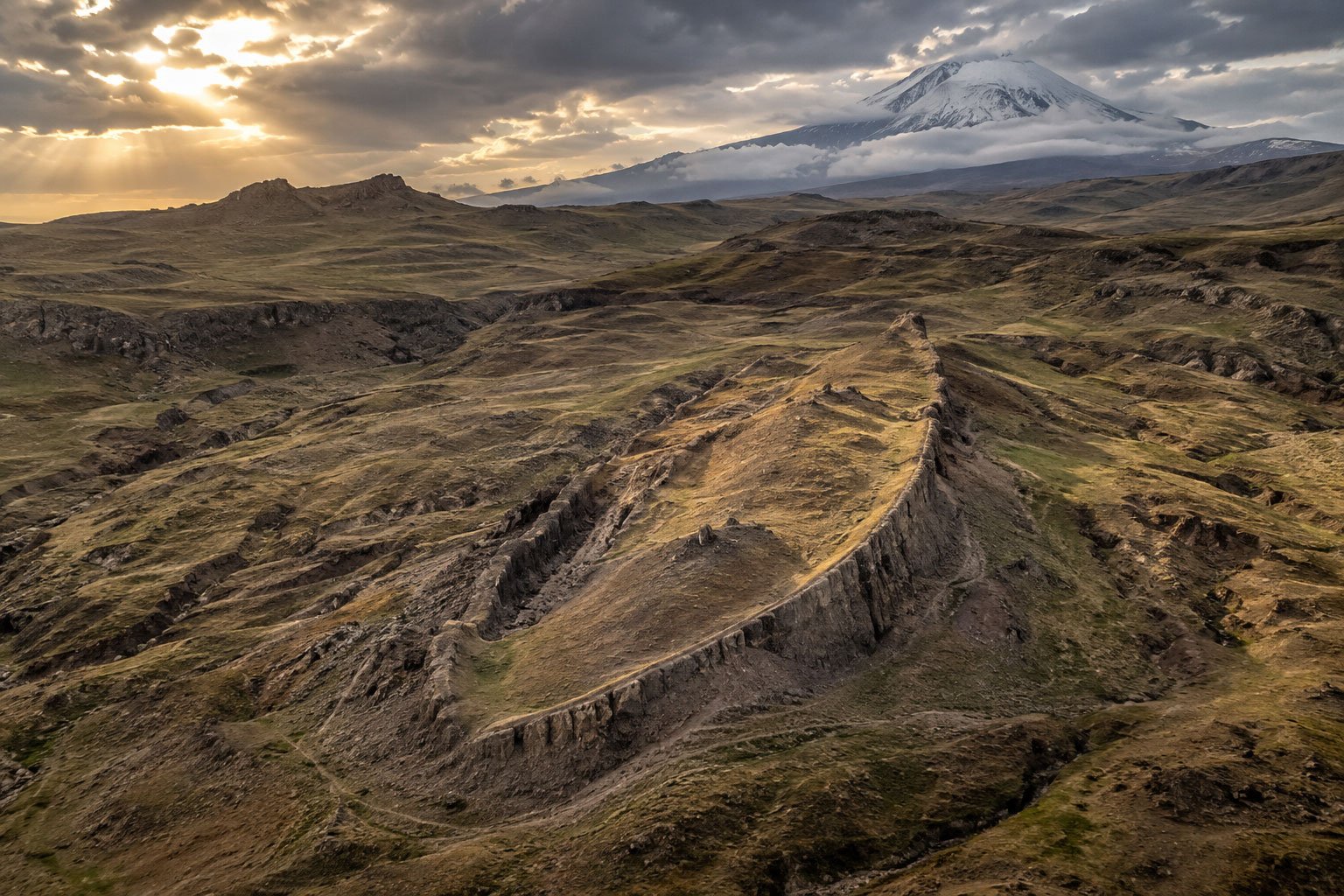
New radar scans have detected angular cavities and unusual soil readings beneath Türkiye’s boat-shaped Durupınar Formation. Is it merely geology—or the lingering imprint of Noah’s Ark?

New radar work at Türkiye’s mysterious Durupınar Formation has revealed angular cavities and unusual soil readings beneath a landmark shaped remarkably like a ship.
High in the rugged country of eastern Türkiye, approximately 18 miles south of Mount Ararat, an enormous stone formation rises from the earth.
From the air, its outline is difficult to ignore. It resembles the remains of a great vessel—pointed at one end, rounded at the other and measuring approximately 538 feet long.
For generations, believers have asked an extraordinary question: Could this be the final resting place of Noah’s Ark?
Now, a new scientific investigation is looking beneath the surface—and its preliminary findings have reopened one of archaeology’s most persistent mysteries.
The Durupınar Formation was brought to international attention in 1959 after Turkish Army Captain İlhan Durupınar noticed its ship-like outline in aerial photographs.
Numerous expeditions followed. Some investigators claimed to find evidence of petrified wood, iron fasteners and enormous anchor stones. Geologists countered that the formation was an unusual but entirely natural arrangement of folded rock and hardened mud.
The argument appeared destined to remain where it had begun: suspended between faith and geology.
During the summer of 2026, however, a team led by Professor Cenker Atila of Sivas Cumhuriyet University began what the university describes as the most extensive archaeological and geological examination yet conducted at the location.
Researchers created detailed three-dimensional maps, established precise GPS reference points and scanned beneath the formation with advanced ground-penetrating radar.
According to the university’s preliminary announcement, the instruments detected regularly angled underground cavities. Researchers say the readings raise the possibility that compartments or structural spaces once existed beneath the surface.
Soil samples reportedly added another unexpected detail: carbon levels inside the boat-shaped outline were approximately 40 percent higher than those measured outside it.
Could that difference represent the remains of ancient organic material—including timber—or is it another product of the region’s complicated geology?
For now, nobody can say.
The formation’s dimensions have always fueled the controversy.
Genesis describes the Ark as 300 cubits long and 50 cubits wide. Because the exact length of an ancient cubit varied, some interpretations place the vessel remarkably close to the dimensions of the Durupınar Formation.
The Bible also states that the Ark came to rest upon the “mountains of Ararat”—a regional description rather than an unmistakable reference to the modern summit bearing that name.
These similarities are intriguing, but resemblance is not identification. Nature regularly produces formations that look artificial, from stone faces to near-perfect circles and geometric columns.
Durupınar may simply be one of geology’s more convincing illusions.
Previous examinations produced powerful reasons for skepticism.
Geologists Lorence Collins and David Fasold concluded in a 1996 analysis that Durupınar was a natural rock formation created by folded sedimentary layers. Materials presented as petrified wood or metal fittings were identified as metamorphosed rock and concentrations of naturally occurring minerals.
Fasold’s involvement was particularly notable. Once an enthusiastic supporter of the Ark interpretation, he later expressed serious doubts after further geological study.
That history places a heavy burden on the current investigation. Radar anomalies are not photographs of buried rooms, and elevated carbon does not automatically mean that an ancient wooden ship lies beneath the soil. Both findings could have natural explanations.
The researchers themselves have not announced the discovery of Noah’s Ark. Core samples and soil specimens are still being studied, with fuller scientific results expected during 2027.
The new investigation may finally reveal how the formation was created. It could confirm an extraordinary natural process—or uncover evidence that something constructed once occupied the site.
Until the laboratory work is completed, Durupınar remains exactly what it has been for decades: a great stone vessel caught between history, geology and belief.
Perhaps nothing lies beneath it except folded rock and the human desire to find physical evidence for an ancient story.
But if it is merely a coincidence, nature chose a hauntingly appropriate shape.
Is the Durupınar Formation only a geological illusion—or has Noah’s Ark left its shadow beneath the earth?
You be the judge.
The Durupınar Formation lies in eastern Türkiye, approximately 18 miles south of Mount Ararat.