Physical Address
304 North Cardinal St.
Dorchester Center, MA 02124
Physical Address
304 North Cardinal St.
Dorchester Center, MA 02124
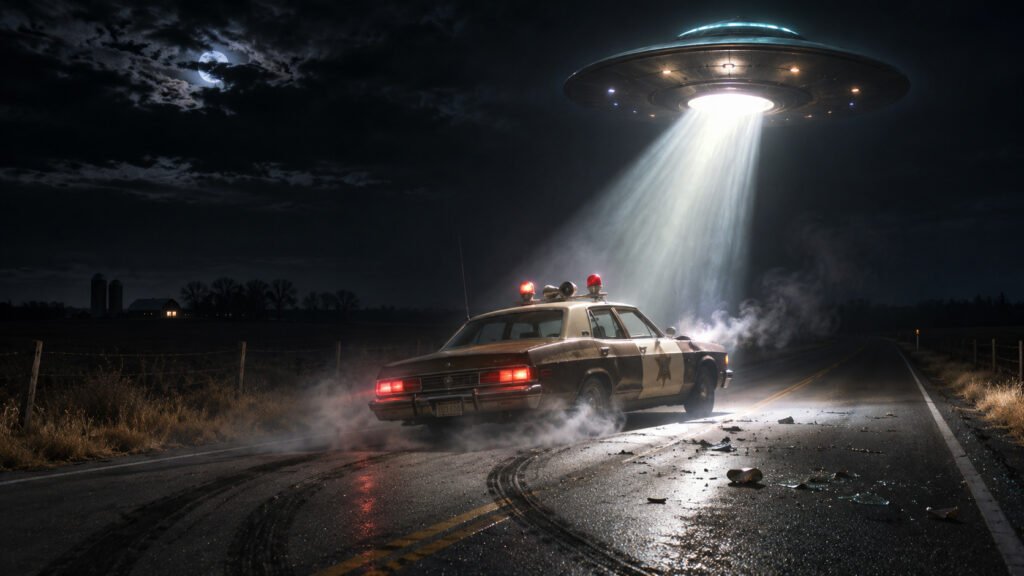
The Val Johnson Incident: A Minnesota Deputy, 39 Missing Minutes, and a Mystery That Refuses to Die
In the dead of night on a lonely Minnesota highway, a sheriff’s deputy encountered a brilliant light. Moments later, his patrol car was wrecked, his eyes injured, and nearly forty minutes had vanished from his recollection. Forty-seven years later, investigators still have no universally accepted explanation.
By Joe Garner | The Garner Report
Case File: GRUAP-2
Date of Incident: August 27, 1979
Location: Marshall County, Minnesota, USA
Classification: Close Encounter / Physical Trace / Vehicle Interference
Status: Unresolved
There are stretches of highway in northern Minnesota where the darkness seems to go on forever.
The farmland is flat, the roads run straight, and on a moonless night, the only light for miles may be the headlights of a passing automobile.
In the early morning hours of August 27, 1979, Marshall County Deputy Sheriff Val Johnson was driving his patrol car along one of those isolated roads, approximately ten miles west of the small community of Stephen.
It was a routine patrol, and nothing suggested that the evening would be anything other than ordinary.
Then Johnson noticed a light.
At approximately 1:40 a.m., as he approached the intersection of County Road 5 and Minnesota Highway 220, he spotted something luminous to the south.
The light appeared exceptionally bright, sharply defined, and positioned just a few feet above the ground.
Johnson initially suspected an aircraft in trouble. Perhaps a small plane was attempting an emergency landing on the rural highway.
He turned south to investigate.
As the deputy drove toward the mysterious illumination, something peculiar happened. The light appeared to remain stationary despite his approach.
Then, without warning, it seemed to rush directly toward him.
The interior of his patrol car erupted in brilliant white light.
Johnson heard glass breaking.
And then his recollection ended.
When he regained awareness, the vehicle was motionless, its windshield shattered, and the engine no longer running.
His eyes burned painfully. He had difficulty seeing.
He reached for his police radio and called for assistance.
The time recorded by dispatch was approximately 2:19 a.m.
Thirty-nine minutes had elapsed since the reported beginning of the encounter.
What happened during that interval remains unknown.
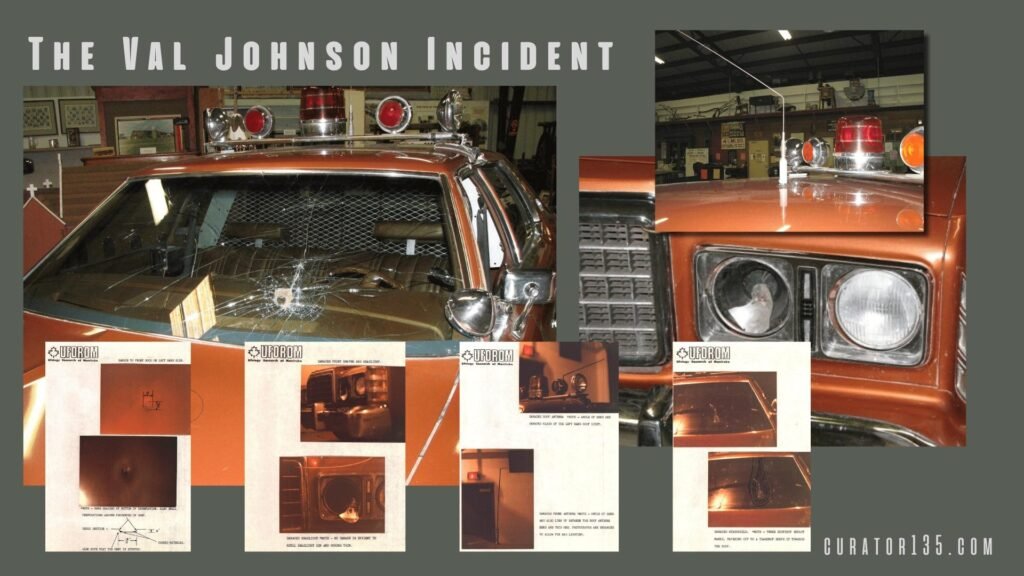
When another deputy arrived, the scene was unlike an ordinary roadside breakdown.
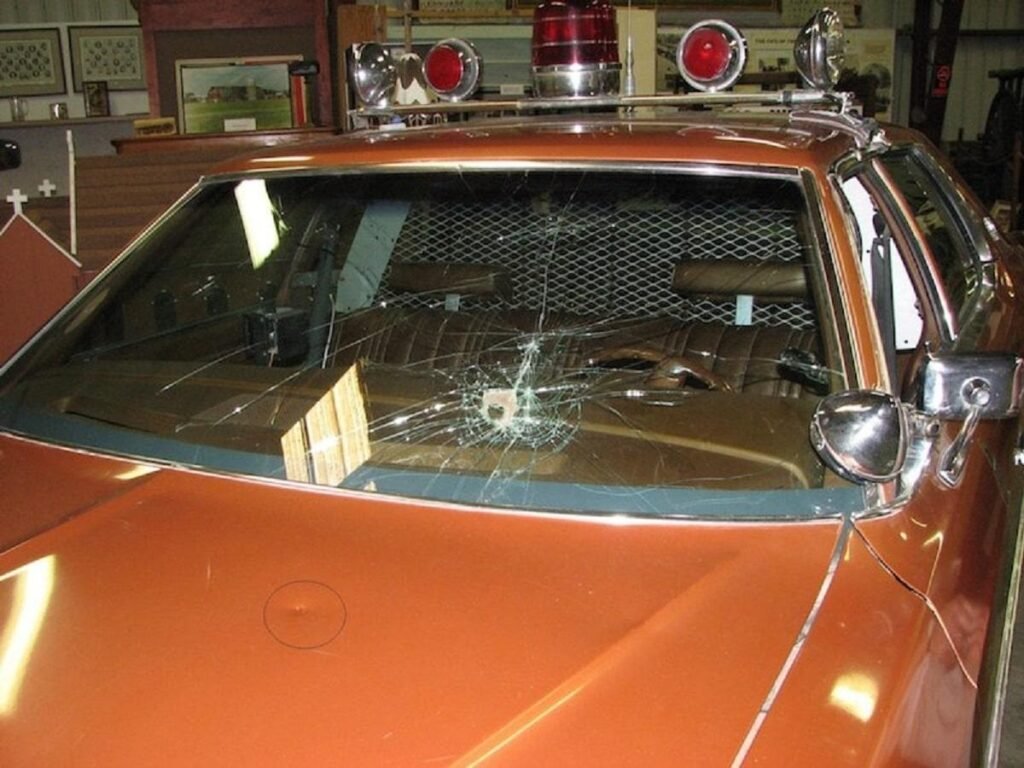
Johnson’s 1977 Ford LTD patrol car had come to rest at an angle across the roadway. Its windshield was extensively cracked. One headlight was broken, a red emergency light was damaged, and two radio antennas had been bent sharply backward.
There was also a small dent in the hood.
The car had apparently continued a considerable distance after the initial damage occurred. Investigators documented approximately 854 feet between glass found near the roadway and the beginning of the vehicle’s skid marks, followed by roughly another 99 feet of skidding.
Yet there was no immediately apparent explanation for what had struck the automobile.
Johnson could not identify another vehicle, an animal, or any conventional obstruction.
His colleagues examined the scene and the damaged patrol car. The physical aftermath was undeniable, even if the cause was not.
The deputy himself was shaken and injured.
Medical examinations documented irritation and redness in his eyes. An initial physician compared the symptoms to mild welder’s burns, an injury associated with exposure to intense ultraviolet light.
A later specialist examination, however, found relatively mild irritation without visible lasting ocular damage at the time of that examination.
The symptoms were real enough to require medical attention, but they did not independently establish the nature of the light that Johnson reported seeing.
Then investigators encountered another peculiar detail.
Johnson routinely synchronized his wristwatch and the patrol car’s dashboard clock with official time at the beginning of his shift.
Following the incident, both timepieces reportedly showed the same discrepancy.
They were approximately fourteen minutes slow.
One was a conventional mechanical wristwatch. The other was an electrically powered automobile clock.
How could two different clocks, operating on entirely different mechanisms, register the same apparent loss of time?
For UFO researchers, the coincidence was intriguing.
Some suggested the clocks might have been affected by an extraordinary electromagnetic event. Others wondered whether the discrepancy might somehow relate to Johnson’s interruption of consciousness.
But an important distinction must be made.
The thirty-nine-minute interval and the fourteen-minute discrepancy were not the same phenomenon.
The longer interval was calculated from the reported encounter to Johnson’s radio call. It does not prove he was unconscious for every minute.
Likewise, investigators did not continuously observe either clock stopping and restarting. What they documented was the reported discrepancy afterward.
No controlled reconstruction demonstrated that an unknown energy field had altered both devices.
Nevertheless, the two clocks became one of the most enduring and frequently discussed features of the case.
Marshall County Sheriff Dennis Brekke took the incident seriously.
This was not simply a motorist reporting a strange light in the distance. A deputy had requested assistance, suffered injuries, and returned with a damaged county vehicle.
The sheriff’s department documented the scene and began looking for possible explanations.
Investigators considered an automobile collision, an encounter with an animal, aircraft activity, and other conventional sources of damage.
According to the Minnesota Historical Society, inquiries to aviation authorities failed to identify aircraft scheduled or reported in the immediate area at the relevant time.
The sheriff’s office also contacted the Center for UFO Studies, a civilian research organization whose investigators included Allan Hendry, an experienced analyst of unidentified-object reports.
The Center’s investigators reviewed Johnson’s testimony, physical evidence, the reported clock discrepancy, and the conditions surrounding the encounter.
The vehicle itself attracted particular attention.
Unlike a fleeting light in the sky, here was something investigators could examine.
A cracked windshield. Bent antennas. Damaged lights.
Whatever had happened, it had left marks.
But could those marks reveal what caused them?
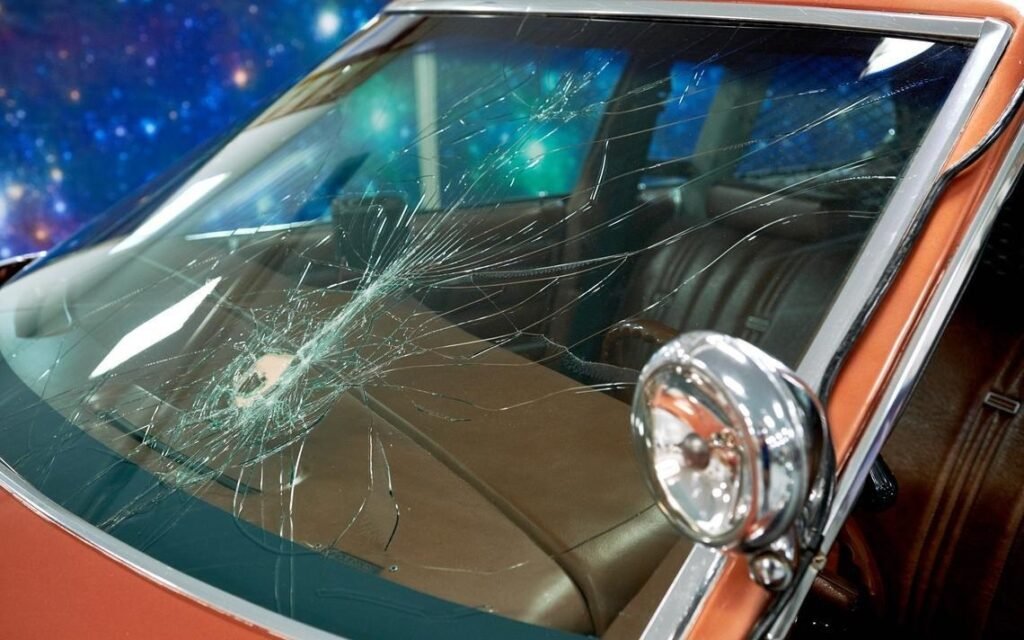
The investigation eventually involved technical specialists, including personnel associated with Ford and Honeywell.
Ford glass specialist Meridan French examined the windshield and identified multiple fracture origins.
His findings pointed toward mechanical forces rather than an extraordinary heating or melting process. The individual types of fracture could be produced through conventional physical loading or impacts, although their apparent combination and sequence were difficult to reconstruct.
Honeywell engineer Roland Wardell also examined the evidence.
His analysis considered particle impacts, the bent antennas, and possible effects involving electrical or other forces.
Some damaged components contained material consistent with ordinary roadside minerals or stones.
Testing did not establish unusual residual radiation or magnetism.
The antennas presented a different problem because their bending did not correspond neatly to the impact marks on other components.
Wardell considered possible electrical, mechanical, and aerodynamic explanations but did not demonstrate a complete reconstruction that accounted for everything.
The examinations were therefore intriguing without being conclusive.
They showed that physical evidence existed and that specialists had difficulty accounting for all of it through one simple event.
They did not establish that an extraterrestrial spacecraft, unknown propulsion system, or extraordinary energy field was responsible.
That distinction remains essential to understanding the case.
Among the more interesting proposals was ball lightning.
This rare and incompletely understood atmospheric phenomenon is commonly described as a luminous sphere that can appear during electrical disturbances.
Descriptions of ball lightning sometimes involve floating lights, sudden movement, and unusual interactions with nearby objects.
Could Johnson have encountered an exceptionally powerful electrical phenomenon?
Some investigators considered the possibility.
It offers a potential natural explanation for the brilliant illumination and perhaps some of the reported effects.
But major questions remain.
There was no direct measurement of an electrical discharge at the scene. No instrument captured the luminous object. And the available evidence did not establish how ball lightning could have produced the entire pattern of vehicle damage, the medical symptoms, and the clock discrepancy.
An ordinary collision or road-debris event presents another possibility.
Mechanical forces can break windshields, damage lights, and bend vehicle components. Johnson’s subsequent loss of awareness might potentially have resulted from injury or another medical event.
Yet no conventional collision sequence was conclusively demonstrated.
Investigators also had to consider the possibility of mistaken recollection, incomplete observations, or even deliberate fabrication.
None of those possibilities can be eliminated solely because the incident was unusual.
At the same time, proposing an explanation is not the same as proving it.
The historical record supports several competing hypotheses, but no single reconstruction has achieved universal acceptance.
Perhaps one of the most revealing aspects of this case is Johnson’s own response.
He did not claim to have encountered extraterrestrial beings.
He did not describe a spacecraft with windows, occupants, or advanced machinery.
He described a brilliant light, a sudden impact-like experience, and an interruption in his awareness.
In the years that followed, the encounter brought extraordinary publicity.
Johnson appeared on national television, gave interviews, and found himself associated with one of the most famous police-related UFO incidents in American history.
The attention also placed a strain on his personal life.
For a man who had been performing an ordinary night’s work, becoming the central figure in a national mystery was not necessarily a welcome experience.
In a 2015 interview reported by Minnesota Public Radio, Johnson remained reluctant to speculate about what had happened.
He had experienced something he could not explain.
That did not mean he knew what it was.
His restraint is worth remembering when evaluating a case that others have interpreted in far more extraordinary terms.
In many UFO investigations, the physical evidence is long gone.
Witnesses pass away. Photographs disappear. Records are misplaced. Locations change beyond recognition.
The Val Johnson incident is unusual because a central piece of evidence survives.
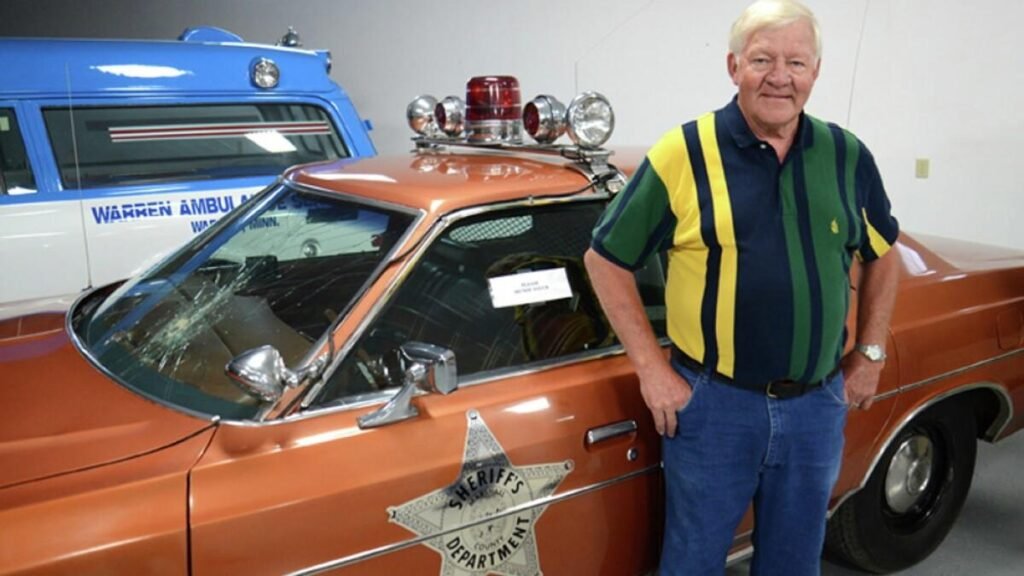
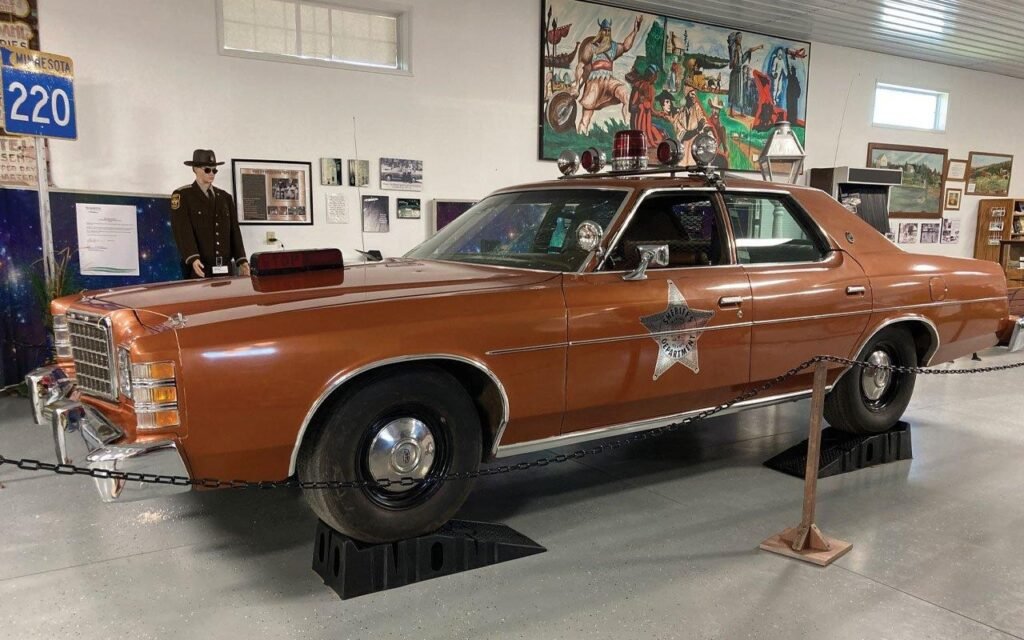
His damaged 1977 Ford LTD patrol car was preserved and eventually placed on exhibition at the Marshall County Historical Society Museum in Warren, Minnesota.
Visitors can still see the vehicle associated with that August night in 1979.
The cracked windshield, damaged equipment, and distinctive patrol-car body make the exhibit a tangible connection to the investigation.
The vehicle is not proof of extraterrestrial visitation.
It is proof that an unusual reported encounter produced a documented law enforcement investigation and left a physical artifact that has endured for decades.
That is a far stronger historical foundation than an anonymous story passed from one person to another.
And the public fascination has not faded.
On October 24, 2026, Pioneer PBS released a new episode of its Hiseerie documentary series examining the incident.
Nearly half a century after Johnson’s radio call, the questions remain compelling enough for another generation to investigate.
What can reasonably be established about the Val Johnson incident?
Documented evidence
Unresolved questions
Important limitations
Johnson was the sole direct witness to the reported approaching light. No verified photograph, radar recording, or independent instrument measurement captured the object.
Although technical examinations produced unusual observations, the available historical record does not establish a scientifically verified extraordinary cause.
The case remains unresolved, but unresolved does not necessarily mean inexplicable.
It means the evidence presently available is insufficient to establish one explanation with confidence.
A lonely highway.
A brilliant light.
A patrol car with a shattered windshield.
Two clocks showing the same unexplained discrepancy.
And one sheriff’s deputy who could never fully account for what happened during an extraordinary stretch of an otherwise ordinary night.
The Val Johnson incident continues to occupy a distinctive place in the history of unidentified aerial phenomena because it combines human testimony with documented physical damage and contemporary investigation.
It is tempting to fill the remaining gaps with a story about visitors from another world.
It is equally tempting to dismiss everything as an unusual accident.
But the historical evidence does not give us the luxury of certainty in either direction.
Somewhere along Highway 220, on an August morning in 1979, something happened to Deputy Val Johnson and his patrol car.
The damage survived.
The questions survived.
And the explanation remains elusive.
You be the judge.