Blurry Photograph Leads Scientists to Mysterious New Monkey in Congo
LOMAMI NATIONAL PARK, Democratic Republic of Congo —** It began, as many great mysteries do, with a shadow in the trees and a photograph that raised more questions than it answered.
In 2008, explorers traveling through the remote forests of the Lomami Basin aimed their camera toward the high canopy and captured a partially obscured image of an unfamiliar monkey. Only part of the animal could be seen, but the experienced field team suspected they were looking at something not previously documented in the region.
Then, just as suddenly as it had appeared, the mysterious creature vanished.
For the next decade, there were no confirmed reports.
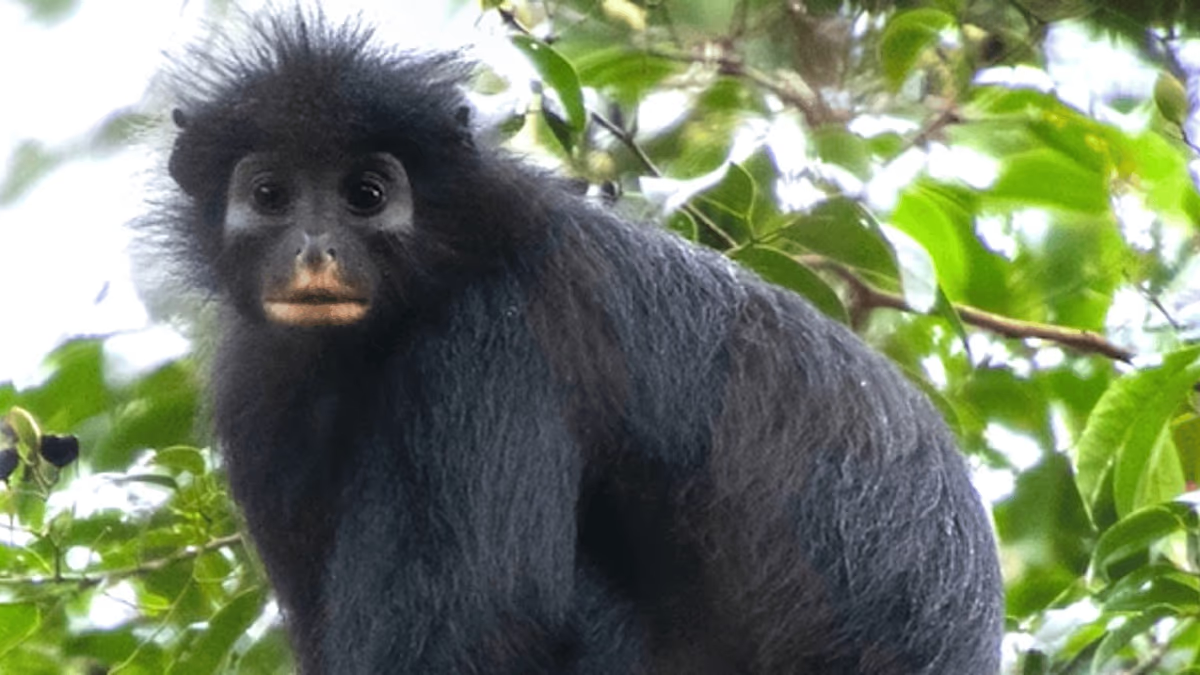
Colobus congoensis monkey, known locally as Likweli, in the Democratic Republic of Congo.Credit :
Daniel Rosengren
The trail grew cold until November 2018, when a surveillance patrol encountered a black monkey with pale markings around its mouth and a noticeable white patch near its hindquarters. These unusual features did not match any primate known to inhabit that portion of the Congo Basin.
Over the following months, researchers located and photographed the animal several more times. Comparisons with the original 2008 image suggested that the newly observed monkeys belonged to the same mysterious population first glimpsed ten years earlier. ([PLOS][1])
Now, after years of field observations, genetic testing, anatomical comparisons and analysis of its calls, scientists have formally named the animal **Colobus congoensis**. Local people in portions of the region call it **Likweli**, while another local name reportedly translates to “the branch shaker.”
The species was formally described in the scientific journal *PLOS One* on July 15, 2026. Researchers say it is only the fifth previously unknown African monkey species discovered during the past 75 years. ([PLOS][1])
Likweli has glossy black fur, a long sweeping tail and a striking orange-cream patch surrounding its mouth and portions of its nose. The pale markings create an almost mask-like appearance against its dark face. Researchers say it is smaller than several related colobus monkeys, weighing roughly 15 pounds. ([Florida Atlantic University][2])
Its voice is also distinctive.
The monkey produces deep roars and snorting sounds with an acoustic structure that researchers found different from those of other nearby species. Genetic evidence indicates its closest known relative is the black colobus, despite the two populations being separated by more than 1,200 kilometers.
Between 2018 and 2022, researchers recorded 114 field observations. Yet the species appears confined to an estimated range of only 1,700 square kilometers between the Lomami and Congo, or Lualaba, river systems. It remains so elusive that residents in only eight of 52 surveyed communities near its habitat could accurately describe it.
That secrecy may have protected Likweli from scientific attention, but it may not protect it from the modern world.
Researchers are recommending that the species receive a preliminary endangered classification because of its small population, restricted territory, hunting pressure and possible future habitat loss. Much of its known range lies within Lomami National Park, making protection of the park and cooperation with local communities crucial to its survival.
The discovery serves as a reminder that a blurry photograph is not always proof of fantasy.
Sometimes, hidden behind the grain and shadow, there truly is something waiting to be found.
And deep within the Congo rainforest, one mystery has finally stepped into focus.