Physical Address
304 North Cardinal St.
Dorchester Center, MA 02124
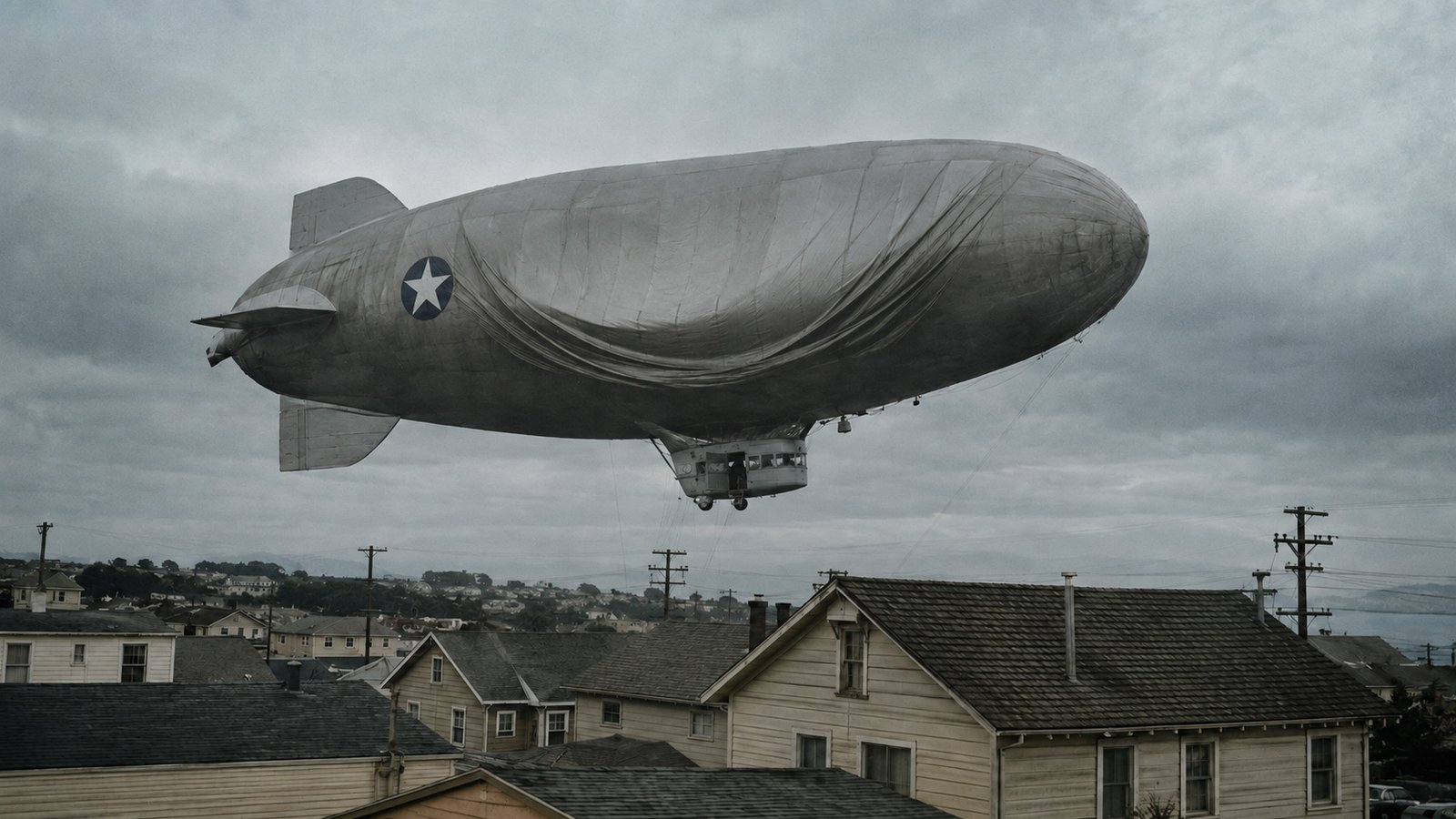
Shortly after six o’clock on the morning of August 16, 1942, Navy blimp L-8 lifted away from Treasure Island in San Francisco Bay.
At the controls were Lieutenant Ernest DeWitt Cody and Ensign Charles Ellis Adams. Their orders were straightforward: patrol the California coast and watch for Japanese submarines.
The United States had been at war for only eight months, and fears of an enemy attack along the West Coast were running high. L-8 carried depth charges, a machine gun and enough fuel to remain airborne for hours.
At 7:42 a.m., Cody radioed that the crew had spotted a suspicious oil slick near the Farallon Islands.
“Stand by,” the message instructed.
It was the last transmission ever received from either man.
Nearby ships watched L-8 circle the oil slick. Witnesses aboard a fishing vessel reported seeing two men inside the control car.
After nearly an hour, the blimp dropped ballast, gained altitude and turned back toward San Francisco. Nothing about its departure appeared alarming.
Then the radio went silent.
Search aircraft later spotted L-8 approaching the coast. One pilot thought the blimp appeared to be under control. But shortly after eleven o’clock, witnesses near Ocean Beach saw it hanging low over the water with its engines silent and its envelope sagging.
The airship briefly touched the beach. Before anyone could secure it, L-8 rose again and drifted inland.
Thousands watched as the crippled blimp scraped across rooftops, struck utility wires and settled onto a residential street in Daly City.
Firefighters rushed toward the control car expecting to rescue its crew.
Nobody was inside.
The door stood open. The radio still worked. Three parachutes and the life raft remained aboard. A briefcase containing classified material sat behind the pilot’s seat, and the engines and flight controls showed no catastrophic failure.
Two life jackets were missing—but regulations required Cody and Adams to wear them while flying over water.
The Navy searched the coast for three days. Neither the men nor their life jackets were found.
The most practical theory holds that one crewman fell while leaning through the open doorway to examine the oil slick. The second man may have attempted a rescue, causing both to tumble into the Pacific.
It is possible—but it leaves one stubborn question: Why didn’t either experienced aviator radio for help?
Other theories suggested capture by a Japanese submarine, a concealed stowaway, desertion or violence aboard the blimp. None produced supporting evidence.
The Navy’s investigation found no evidence of fire, enemy attack, mechanical failure or voluntary abandonment. After questioning dozens of witnesses, investigators concluded that the men probably left the aircraft involuntarily—but could not determine how.
The case was ultimately classified as unknown and undetermined.
The answer may be painfully ordinary: an accident over open water followed by an unsuccessful rescue attempt. Yet the evidence refuses to form a complete picture.
Two experienced airmen disappeared from a slow-moving aircraft while ships watched from below and military planes searched from above. Their radio worked. Their emergency equipment remained aboard. Their blimp continued home alone.
That does not require submarines, secret missions or visitors from somewhere beyond the clouds. It requires only one missing piece—the moment when two men vanished from an aircraft that refused to fall with them.
More than eight decades later, that moment remains lost over the Pacific.
Navy blimp L-8 returned from its patrol. Lieutenant Cody and Ensign Adams did not.
Was it a tragic accident, a failed rescue—or something investigators never considered?
The investigation continues.
You be the judge.
Naval History and Heritage Command: L-8 Ghost Ship
https://www.history.navy.mil/content/history/museums/nnam/explore/collections/aircraft/l/l-8-ghost-ship.html
Smithsonian Magazine: The 80-Year Mystery of L-8
https://www.smithsonianmag.com/history/the-80-year-mystery-of-the-us-navys-ghost-blimp-180980531/
National Naval Aviation Museum: L-8 Control Car
https://navalaviationmuseum.org/aircraft_exhibits/l-8-control-car/
USNI News: The Mystery of the Navy’s Ghost Blimp
https://news.usni.org/2017/08/17/usni-news-video-mystery-navys-ghose-blimp