Physical Address
304 North Cardinal St.
Dorchester Center, MA 02124
Physical Address
304 North Cardinal St.
Dorchester Center, MA 02124
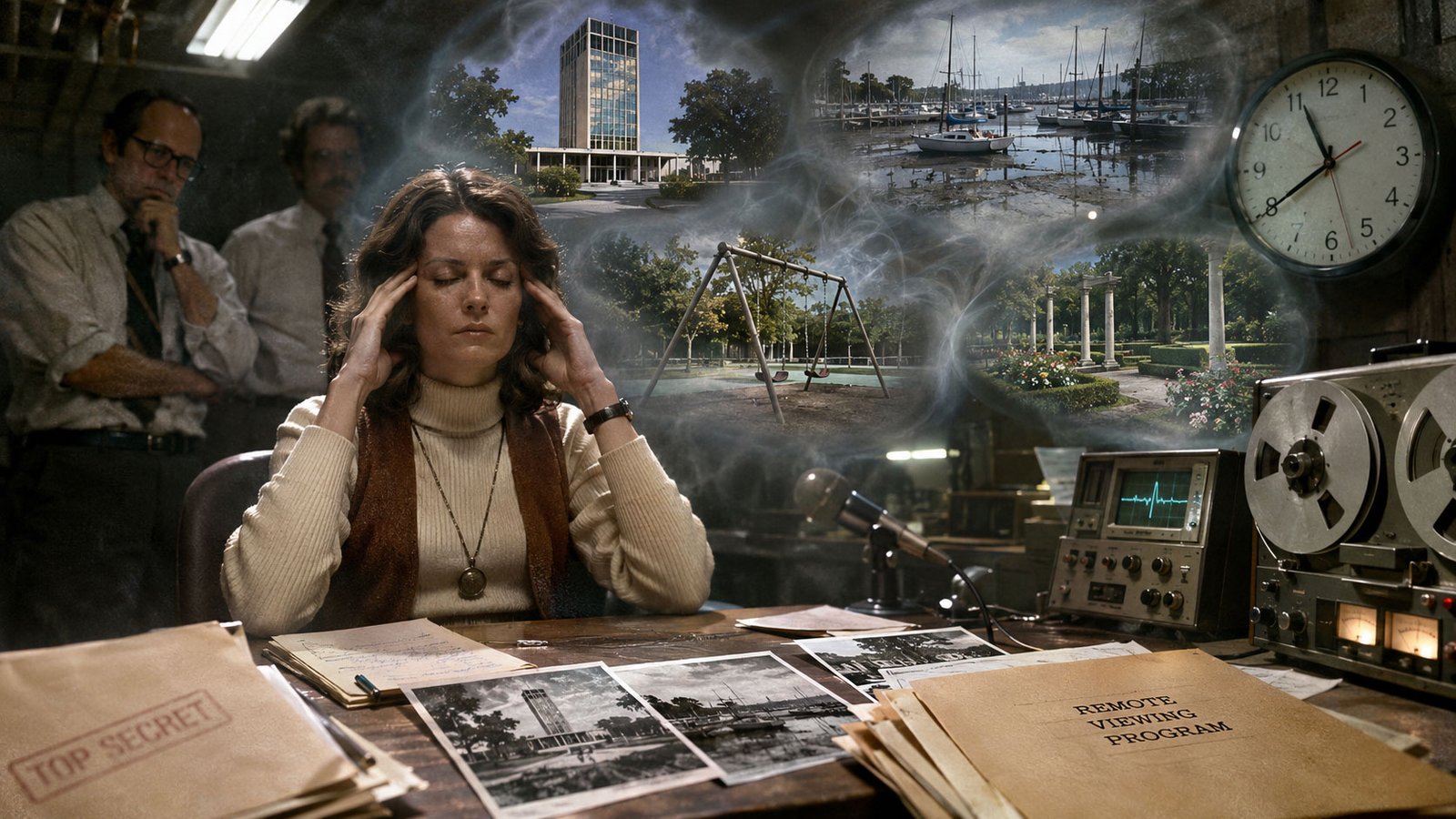
Inside a Cold War psychic experiment where a photographer allegedly described four places before anyone knew which ones would be chosen.
MENLO PARK, CALIFORNIA — 1970s.
In a laboratory south of San Francisco, a woman was about to participate in an experiment that seemed better suited to the pages of Amazing Stories than the files of an American research institution.
Her name was Hella Hammid.
She wasn’t a secret agent. She wasn’t a military officer. She was a professional photographer.
But scientists working on government-funded psychic research believed she might possess a remarkable ability: the capacity to describe places she had never visited — and, more astonishingly, places that had not yet been selected.
If their experiment succeeded, it would suggest something extraordinary.
Perhaps the mind could see tomorrow.
The setting was Stanford Research Institute, commonly known as SRI, in Menlo Park, California.
By the early 1970s, physicists Harold E. Puthoff and Russell Targ were investigating an unconventional possibility: that certain individuals could acquire information about distant locations without using their five ordinary senses.
Their research attracted the attention and funding of American intelligence organizations during the Cold War.
The stakes were considerable.
If the Soviets were developing psychic intelligence capabilities, the United States wanted to understand whether such abilities existed — and whether they could be exploited.
Among the individuals investigated at SRI were artist and psychic claimant Ingo Swann and former police commissioner Pat Price.
Hammid was different.
She had been recruited as a comparatively inexperienced participant, rather than someone who had built a reputation around psychic abilities.
Yet researchers reported that her descriptions of distant locations were intriguing enough to justify a more ambitious experiment.
They wanted to know whether she could describe a destination before it had even been chosen.
The procedure was deceptively simple.
One researcher would leave the SRI laboratory carrying ten sealed envelopes, each containing instructions identifying a potential destination somewhere in the surrounding region.
Back at the laboratory, Hammid would attempt to describe where the traveler would eventually arrive.
But there was a catch.
The destination would not be randomly selected until after Hammid had finished describing it.
The schedule was carefully arranged.
At 10:00 a.m., the traveling experimenter departed by automobile.
At 10:10, Hammid began recording her impressions.
She had fifteen minutes to describe what she perceived.
By 10:25, her session was over.
At 10:30, the traveler used a Texas Instruments SR-51 calculator’s random-number function to select an envelope.
Only then would he proceed toward his destination, where he was expected to arrive at 10:45.
If the procedure worked as intended, Hammid would have completed her observations before anyone knew which destination would be visited.
And then came the results.
One destination was the Palo Alto Yacht Harbor, on the edge of San Francisco Bay.
When the experimenter arrived, the tide was exceptionally low.
Instead of the familiar scene of boats floating beside docks, much of the harbor consisted of exposed mud flats.
Back in the laboratory, Hammid had described a strange, thick, wrinkled surface resembling hardened tar or cooled lava.
The researchers considered the description a striking resemblance to the mud-covered harbor.
There was no mention of boats sailing across sparkling blue water.
Instead, her impressions focused on the unusual texture of the exposed ground.
Coincidence?
Perhaps.
But the next sessions were equally curious.
Another destination was a formal garden near Stanford University Hospital.
Hammid reportedly described a carefully maintained garden, a wall, and a double colonnade.
When she later visited the location, the researchers wrote that she was surprised by the resemblance between her description and the actual architecture.
The details were especially interesting because she had supposedly described them before the destination was randomly selected.
The investigators believed they were observing something beyond ordinary guessing.
But the experiment was still far too small to settle such an extraordinary question.
The third destination was a playground approximately 4.6 kilometers from the laboratory.
Hammid’s impressions included a large black iron triangle, taller than a person.
She also reported hearing a repetitive squeaking sound.
At the destination stood a metal swing set.
According to the research account, its frame resembled the triangular structure she had described, and the swing produced a squeaking noise.
Of the four trials, this may be the most memorable.
A woman sitting in a laboratory had apparently described the shape and sound of an ordinary playground fixture before the traveling researcher selected that destination.
Whether it was paranormal perception or a remarkable coincidence remained an open question.
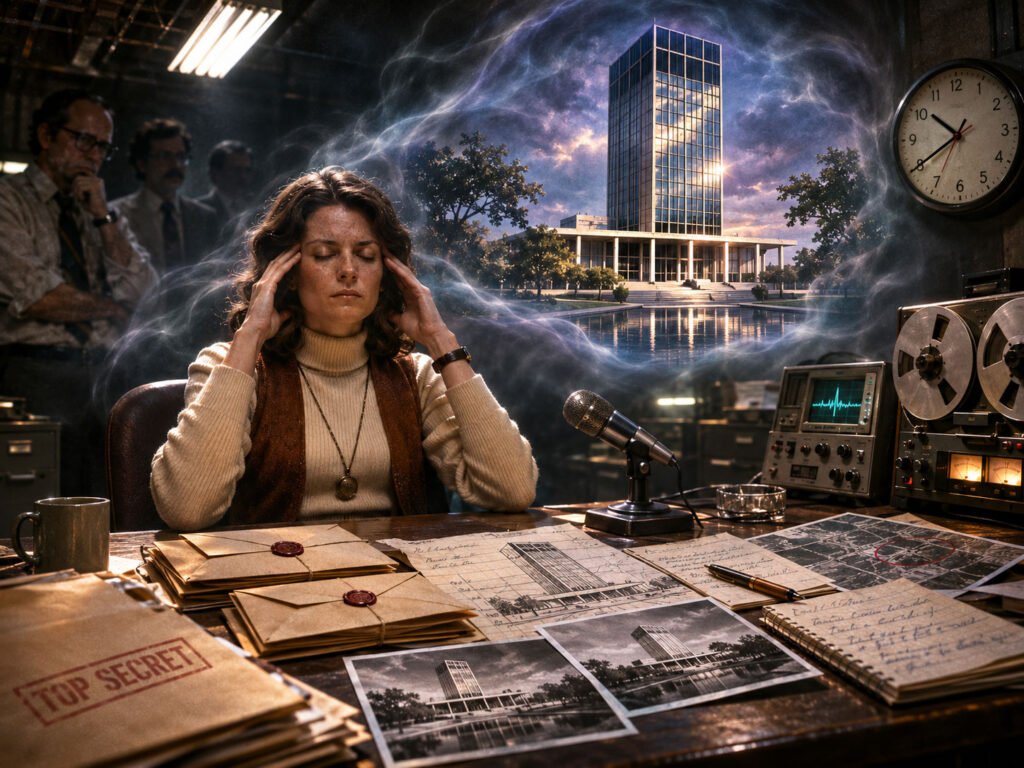
The fourth destination was Palo Alto City Hall.
Hammid described a tall structure covered with glass, situated among city streets.
She also mentioned small cube-like structures near its base.
The researchers associated those impressions with the glass-covered building and the small elevator structures in the adjoining plaza.
After the four sessions, three SRI scientists who had not participated directly in the experiments were asked to match the recorded descriptions with the actual locations.
According to Puthoff and Targ’s published account, all three judges made the four correct matches.
The researchers reported a probability of 0.042 for each judge’s complete matching result under their specified chance model.
It was a provocative finding.
But four trials, even with apparently successful blind matching, could not establish that the human mind had crossed the boundaries of time.
The implications went far beyond playgrounds and gardens.
What if a properly trained individual could describe an enemy installation before a satellite photograph became available?
What if a government analyst could perceive the location of a missing aircraft before the search began?
Or something even more unsettling:
What if a remote viewer could observe an event that had not yet occurred?
The possibility would transform remote viewing from a proposed form of psychic observation into something resembling mental time travel.
The body would remain in the present.
The mind, theoretically, would gather information from the future.
Scientists call the alleged perception of future events precognition.
The central mystery is not simply how such information might travel through space.
It is how information could appear to travel backward through time.
The story did not disappear into a forgotten laboratory notebook.
Puthoff and Targ published their research in the March 1976 issue of Proceedings of the IEEE, under the title A Perceptual Channel for Information Transfer over Kilometer Distances.
Copies of the research later became accessible through declassified U.S. intelligence records.
A subsequent SRI report from June 1980 devoted a section to Future Remote Viewing, describing further experiments involving targets selected after the viewer’s initial description.
Not all of those later results were statistically significant.
Critics of remote viewing have also challenged research methods, judging procedures, and the possibility of ordinary informational cues influencing results.
Government interest, therefore, should not be mistaken for government confirmation.
The historical record establishes that these experiments occurred and that their investigators reported unusual findings.
It does not establish that Hammid, or anyone else, possessed a scientifically demonstrated ability to see the future.
For decades, popular science fiction has portrayed time travel through fantastic machines, glowing portals, and mysterious inventions.
But what if the more intriguing question concerns consciousness itself?
What if our perception of time is incomplete?
The experiments involving Hella Hammid raise such questions without providing definitive answers.
Four destinations. A set of sealed envelopes. A random selection made after the descriptions were recorded.
And a group of researchers who believed they had encountered something worth investigating.
Was it a statistical coincidence? An overlooked flaw in the experimental design? Or an early glimpse of a phenomenon that remains poorly understood?
Nearly half a century later, the question still makes for one remarkable mystery.
Perhaps the strangest journey through time doesn’t require a machine at all.
Perhaps it begins with the human mind.
You be the judge.
Editor’s note: This article examines historical remote-viewing research and reported experimental results. Precognition and mental time travel have not been scientifically established. The experiments should not be regarded as proof of paranormal abilities.
The strongest source is the original 1976 paper by Puthoff and Targ, which includes diagrams, location descriptions, the experimental schedule, and the reported judging results. STARGATE CIA-RDP96-00787R000500020001-6+1
The June 1980 SRI report also describes later future-viewing experiments and explicitly notes that one six-trial series with Viewer 468 did not achieve statistical significance. STARGATE CIA-RDP96-00787R000500010001-7
For the website, these are useful supporting links: