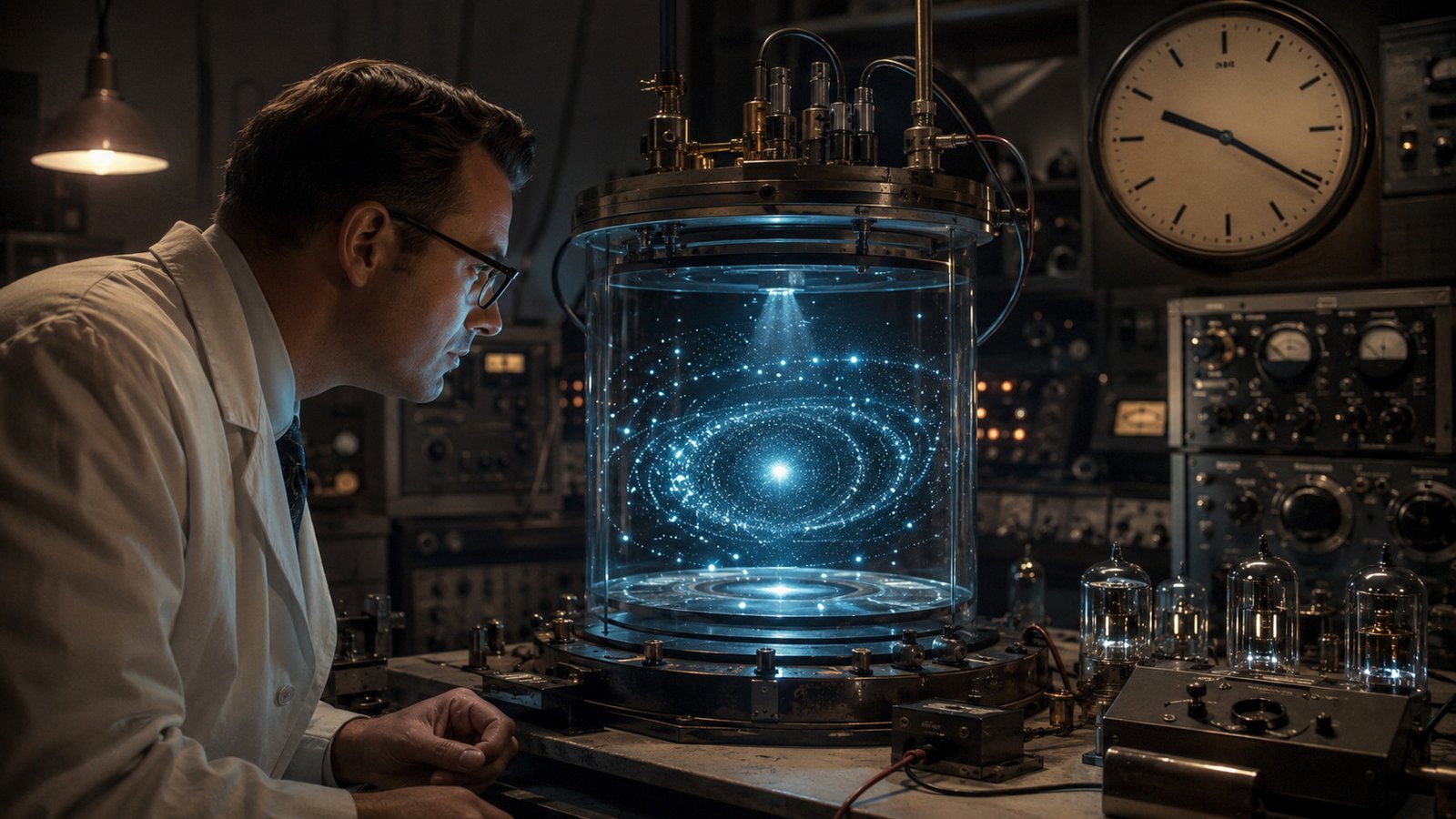
Scientist observing a miniature quantum universe inside a laboratory chamber.

When Time Stood Still

Scientists created a miniature quantum universe that measures its own passage of time. The experiment raises a startling possibility: time may not be a fundamental part of reality at all.

Scientists Built a Tiny Quantum “Universe” Where Time Appeared to Start, Stop and Change Speed—Without a Clock

SUMMARY

A University of Birmingham physicist has created an isolated quantum system in which time emerges from the changing behavior of atoms rather than the ticking of an outside clock.

The experiment did not produce a time machine or send anything into the past. However, it provides laboratory evidence that time may be created by change—and that when change stops, time effectively stops with it.

WHAT WE KNOW

BIRMINGHAM, ENGLAND — Hold the presses—and perhaps the hands on the newsroom clock.

Professor Giovanni Barontini constructed a miniature laboratory “universe” using approximately 24,000 ultracold rubidium atoms. The atoms were chilled to within a few billionths of a degree above absolute zero and sealed inside an isolated quantum system.

A thin barrier created with laser light divided the atoms into two regions: an observed “bright” sector and an unobserved “dark” sector.

Atoms could move between the two regions while the bright portion repeatedly expanded and contracted. Researchers compared the process to a simplified cosmic cycle resembling a Big Bang followed by a Big Crunch.

But the real surprise was not what moved. It was what appeared to move along with it: time.

AI-generated representation of a quantum experiment in which time emerges from changes inside an isolated atomic system.
science looks at mini universe

A UNIVERSE WITHOUT A CLOCK

Certain theories of quantum gravity suggest that the universe, considered as one complete system, may contain no external clock and no fundamental flow of time.

In that picture, past, present and future arise from relationships between events occurring inside the universe.

Barontini’s experiment tested that peculiar proposition in the laboratory.

As the distribution and disorder—or entropy—of the atoms changed, researchers could arrange events into a definite sequence. This internally generated measurement was called “entropic time.”

When the atomic distribution changed rapidly, the system’s internal time moved more quickly. When that change slowed, so did time. When the distribution remained unchanged, time effectively stopped.

The model also produced a consistent “arrow of time,” allowing researchers to distinguish before from after even while the miniature universe expanded and collapsed.

DID SCIENTISTS STOP TIME?

Not quite.

No laboratory clock froze, no scientist disappeared into yesterday and nobody returned with next week’s newspaper.

The researchers did not stop ordinary time or send matter or information into the past. What they demonstrated was that an isolated quantum system could create its own useful measurement of time without consulting an outside clock.

Nevertheless, the implications are difficult to ignore.

If time is produced by change rather than serving as a permanent stage upon which change occurs, our familiar division between past, present and future may not describe reality at its deepest level.

Time could be somewhat like temperature: unquestionably real in everyday life, yet emerging from the collective behavior of smaller things.

EVIDENCE & SOURCES

The peer-reviewed study, “Testing the Problem of Time With Cold Atoms,” was published in Physical Review Research on June 11, 2026.

The experiment demonstrated that an internally generated form of entropic time could correctly order repeated cycles of expansion and collapse. Researchers also developed a version of the Schrödinger equation using this internal measurement of time.

University of Birmingham:
https://www.birmingham.ac.uk/news/2026/scientist-creates-miniuniverse-to-measure-time-without-a-clock

Physical Review Research:
https://journals.aps.org/prresearch/abstract/10.1103/1h9j-df4k

WHY IT MATTERS

The miniature universe provides scientists with a controlled laboratory model for examining questions once confined to theoretical equations.

Similar systems may eventually help researchers investigate quantum gravity, the early universe, simulated black holes and the mysterious origin of time’s one-way direction.

The experiment does not make time travel possible. But before anyone can determine whether journeys through time are possible, science must first understand what time actually is.

THE GARNER REPORT TAKE

For generations, time has been treated as the universe’s master clock—always running, always moving forward and never waiting for anyone.

This experiment suggests something considerably stranger.

Perhaps the clock is not hanging outside the universe at all. Perhaps it is assembled inside the universe, moment by moment, from every particle that moves and every condition that changes.

If so, time may not be the road upon which reality travels.

It may be the tracks reality leaves behind.

BOTTOM LINE

Science has not built a time machine.

But it may have discovered that time itself is part of the machinery.

You be the judge.

Leave a Reply

Your email address will not be published. Required fields are marked *